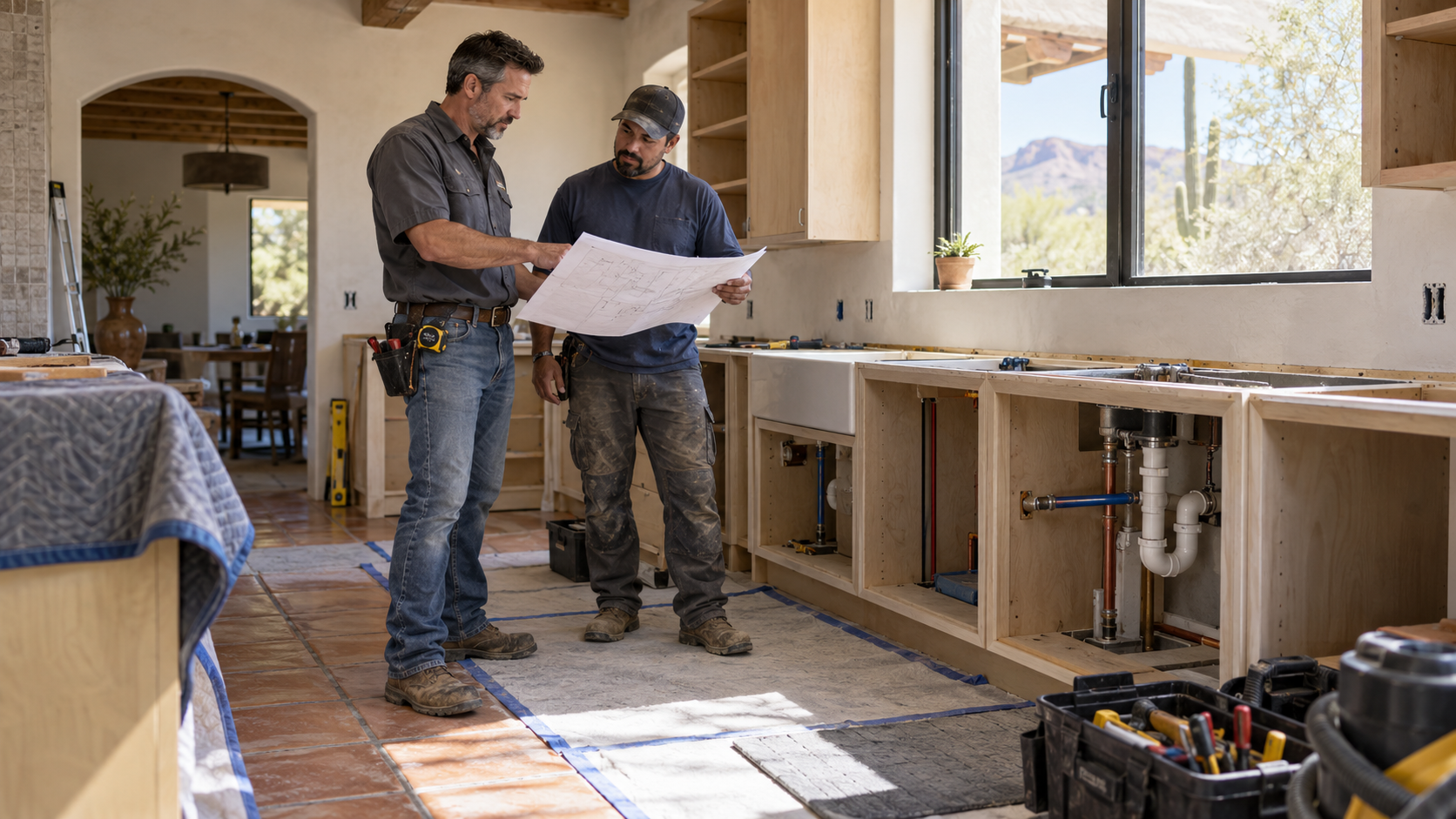
Start With the Condition of the Building
Water damage can turn an unplanned repair into an opportunity to renovate. Before choosing new cabinets or changing a room layout, establish what happened and which parts of the building are affected. The source must be addressed, unsafe conditions evaluated and damaged assemblies assessed. A design proposal becomes more useful when it starts with those findings instead of covering unresolved damage with new finishes.
Keep the recovery scope and renovation wish list in separate records. Replacing damaged drywall may be necessary, while relocating a wall or adding storage is a design choice. Some work overlaps, but each decision needs a clear reason and authorization. This distinction helps an owner compare proposals and discuss insurance questions without assuming that every improvement belongs to the damage claim.
Confirm the Source and Hidden Extent
An obvious leak does not always explain every affected surface. Water may travel under cabinets, through floor openings or into an adjoining room. Ask for an assessment of the relevant concealed layers and for any limitations to be recorded. Planning from the visible stain alone can lead to revisions after demolition exposes a wider problem or reveals an unrelated condition.
Have qualified contractors evaluate affected electrical, mechanical or structural components where appropriate. A room that looks ready for measuring may still contain unstable finishes or unsafe equipment. Access for design work should follow the site’s safety arrangements. Older buildings may also need hazardous-material evaluation before disturbance; that decision belongs early in planning rather than after demolition has already started.
Build a Repair Baseline Before Selecting Upgrades
The repair baseline describes the materials and work needed to restore the affected space under the agreed scope. Record the existing construction, proposed removals and retained elements. Then list optional changes, such as different flooring, upgraded cabinetry or revised lighting. A proposal can price and explain these choices separately, making it easier to see what changes if an upgrade is deferred.
Edmonton Water Damage Restoration offers an external overview of water damage restoration for readers comparing the recovery stages. Use the general sequence to frame questions about assessment and drying, then rely on the professionals responsible for your own building and the requirements that apply where the work takes place.
Choose Materials for the Actual Conditions
A replacement material should suit the room, substrate and expected exposure. A product described as water resistant may still have installation limits and vulnerable joints or edges. Check the manufacturer’s instructions for the entire assembly, including underlayment, adhesive and transitions. A finish cannot compensate for an unresolved leak or a substrate that does not meet its installation requirements.
Compare maintenance needs and repair access alongside appearance. In a utility area, keeping a shutoff accessible may be more valuable than hiding it behind a fixed panel. In a kitchen, consider how an appliance can be removed without damaging surrounding finishes. These are practical design decisions that can be discussed without promising that a particular material will prevent all future water damage.
Make Drying a Prerequisite for Reconstruction
Reconstruction should follow documented assessment and drying of the materials being retained. The equipment leaving the room is only one event in that process. Ask which areas were checked and what criteria were used to determine readiness. Where flooring is involved, the installer may need additional testing to satisfy the selected product’s requirements before accepting the substrate.
The EPA’s moisture guidance emphasizes fixing the water problem and drying affected areas promptly. It also recognizes that some porous materials cannot be cleaned successfully once mold is established. Treat these principles as reasons to resolve the underlying condition before enclosing assemblies. Paint, sealant and new trim are finishing decisions, not evidence that a damp wall cavity has been made ready.
Coordinate Design, Approvals and the Work Sequence
Layout changes can affect wiring, plumbing, ventilation and structural elements. Ask the relevant professionals which permits, drawings or inspections apply to the proposed work. Requirements depend on the jurisdiction and scope. An emergency repair does not automatically authorize a larger remodel, and an approved design does not by itself show that site conditions are ready for construction.
Create a sequence showing the main dependencies: assessment, authorized removal, drying, rough work, inspections where required and finish installation. Identify who releases the next stage. Keep lead times for selected products visible, but avoid letting a delivery date decide whether a wet assembly is closed. If materials are unavailable, agree on an acceptable substitution before ordering rather than improvising during installation.
Make Product Decisions Before Ordering
Keep a selection sheet showing the proposed product, finish, installation system and room. Include any matching accessories or transitions, because a flooring choice can affect door clearances and adjacent surfaces. Ask who checks quantities and which materials require the installer’s acceptance before purchase. Where an owner supplies products, agree on delivery, storage and responsibility for missing components. A late change can affect more than appearance: a different floor thickness or cabinet dimension may change the surrounding work. Review those consequences before authorizing the substitution. Keep the approved selection with the project record so the delivery can be checked against the decision instead of relying on a verbal description given during an earlier visit.
Keep Decisions and Changes Understandable
Should every damaged room be redesigned?
Only if the owner wants that additional scope and the building conditions support it. A focused repair can be appropriate. Compare the practical benefit of each change with its effect on approvals, adjacent finishes and the sequence of work.
Can a contractor promise a fixed completion date immediately?
Early dates may depend on concealed conditions, drying, approvals and material availability. Ask which milestones are confirmed and which remain estimates. Update the plan when the actual condition changes.
What should the final handover include?
Keep the agreed work description, relevant inspections, product information and any remaining maintenance or repair recommendations. Walk through the completed room against the authorized scope. A clear record helps distinguish restored damage, optional improvements and items intentionally left for later work.
Easy steps to create a color palette
Lorem ipsum dolor sit amet, consectetur adipiscing elit lobortis arcu enim urna adipiscing praesent velit viverra sit semper lorem eu cursus vel hendrerit elementum morbi curabitur etiam nibh justo, lorem aliquet donec sed sit mi dignissim at ante massa mattis.
- Neque sodales ut etiam sit amet nisl purus non tellus orci ac auctor
- Adipiscing elit ut aliquam purus sit amet viverra suspendisse potent
- Mauris commodo quis imperdiet massa tincidunt nunc pulvinar
- Excepteur sint occaecat cupidatat non proident sunt in culpa qui officia
What is a color palette?
Vitae congue eu consequat ac felis placerat vestibulum lectus mauris ultrices cursus sit amet dictum sit amet justo donec enim diam porttitor lacus luctus accumsan tortor posuere praesent tristique magna sit amet purus gravida quis blandit turpis.

Don’t overspend on growth marketing without good retention rates
At risus viverra adipiscing at in tellus integer feugiat nisl pretium fusce id velit ut tortor sagittis orci a scelerisque purus semper eget at lectus urna duis convallis porta nibh venenatis cras sed felis eget neque laoreet suspendisse interdum consectetur libero id faucibus nisl donec pretium vulputate sapien nec sagittis aliquam nunc lobortis mattis aliquam faucibus purus in.
- Neque sodales ut etiam sit amet nisl purus non tellus orci ac auctor
- Adipiscing elit ut aliquam purus sit amet viverra suspendisse potenti
- Mauris commodo quis imperdiet massa tincidunt nunc pulvinar
- Adipiscing elit ut aliquam purus sit amet viverra suspendisse potenti
What’s the ideal customer retention rate?
Nisi quis eleifend quam adipiscing vitae aliquet bibendum enim facilisis gravida neque euismod in pellentesque massa placerat volutpat lacus laoreet non curabitur gravida odio aenean sed adipiscing diam donec adipiscing tristique risus amet est placerat in egestas erat.
“Lorem ipsum dolor sit amet consectetur adipiscing elit, sed do eiusmod tempor incididunt ut labore et dolore magna aliqua enim ad minim veniam.”
Next steps to increase your customer retention
Eget lorem dolor sed viverra ipsum nunc aliquet bibendum felis donec et odio pellentesque diam volutpat commodo sed egestas aliquam sem fringilla ut morbi tincidunt augue interdum velit euismod eu tincidunt tortor aliquam nulla facilisi aenean sed adipiscing diam donec adipiscing ut lectus arcu bibendum at varius vel pharetra nibh venenatis cras sed felis eget.